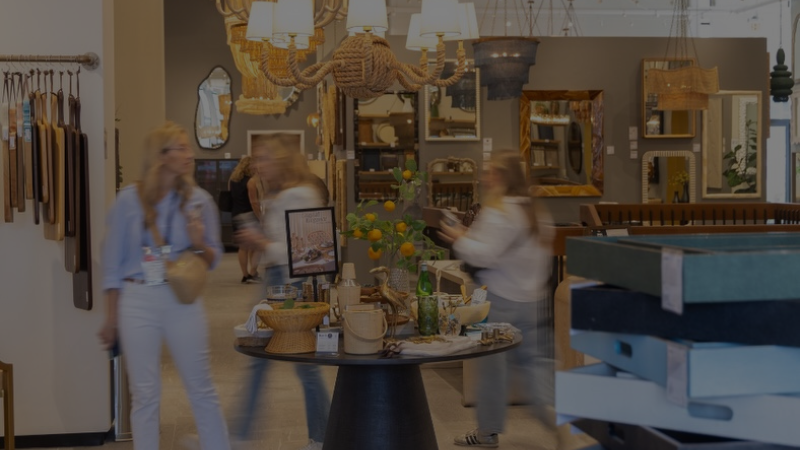
I attended my first High Point Market expecting to learn about furniture, design, and industry trends. Instead, I left thinking about relationships. As someone who works in AI every day, I found myself reflecting on a simple truth: the future isn't AI versus humans—it's AI helping humans do more of what matters.

Matt Whitney
.svg)
September 23, 2026
.svg)
2 Minutes
I recently attended my first High Point Furniture Market, and I arrived with a very specific lens.
For the past several years, I’ve worked deeply in AI. Most recently, I’ve been working in AI-enabled content creation — particularly in the rapidly evolving world of image and video generation, AI-enabled environments (sets and locations), and synthetic talent. For me, my world largely revolves around identifying relevant use cases for AI-enabled content to solve specific pain points for our clients. My company, VIA, is just a simple production company that has always used the most modern tools available (In this case, AI) to drive down cost, improve quality, and speed up timelines.
Rolling into High Point, I understood AI, and I understood advertising. But I didn’t understand furniture. What I discovered was an industry ready for significant transformation.
Before going any further, it’s important to note that AI is not replacing creativity or even production for that matter. And furniture manufacturers don’t have to become tech companies to keep up. Like furniture manufacturing, production is rooted in craftsmanship, beauty, and storytelling. That shouldn’t change! But it’s now obvious that the traditional methods used to create visual content are historically too slow, too expensive, and too difficult to scale for the modern marketplace.
So, surprising to me, manufacturers were eager to talk about AI-enabled content. And everywhere I went, I heard the same thing: “We know AI can help us create content. We just haven’t nailed how.” Some manufacturers have jumped in headfirst. They’ve trained their internal content team, hired AI specialists, signed up for self-serve AI platforms, or even engaged AI content creators. While others are still watching from the sidelines, waiting for best practices to be discovered and clearly defined. Regardless of their status, everyone perked up at the topic of AI-enabled content …
And that was my key takeaway.
Before attending the market, I expected skepticism around AI-enabled content. Instead, I encountered curiosity. Nearly every showroom (Not all of them) was interested in seeing how AI can help make quality advertising assets. Manufacturers specifically wanted to know:
Can AI help us produce more lifestyle imagery?
Can it reduce production costs?
Can it accelerate SKU launches?
Can it customize creative for retailers?
Can it create alternate room scenes?
Can it help us compete digitally without multiplying budgets?
The interest was clear. But so was the uncertainty. Again, many manufacturers have already experimented with AI tools. Some have tested image generators internally. Others have worked with agencies or freelancers producing AI-enhanced content. A few are already integrating AI into portions of their workflow. Yet most seemed caught between fascination and hesitation.
The reason is understandable. Furniture is a visually sensitive category. Small inaccuracies matter. Proportion matters. Materiality matters. Lighting matters. The way upholstery folds matters. The way wood grain reflects light matters. Consumers may not consciously articulate these details, but they instinctively feel them. And because of that, furniture manufacturers don’t merely need “AI images.” They need authentic, believable, brand-safe visual merchandising. That is an entirely different challenge. So, the creative output matters.
The companies seeing the best results are not just “using” AI. They’re utilizing it as one production tool that’s most effective when paired with art direction, merchandising discipline, styling sensibility, photography knowledge, and brand stewardship. In other words, AI is not replacing creative expertise. It’s amplifying the skills of the people who already possess talent. So, if you’re not getting the output you want from AI, take a hard look at who’s operating the tools. You can put me in the same car as Lewis Hamilton, but I won’t be able to give you the same lap time that he can. Know what I mean?!
Of course, I spread this news to everyone I had the pleasure of meeting. I thanked them for their interest and encouraged them to continue learning about AI-enabled content. The interactions were so positive that it made me want to attend my first Atlanta Summer Market. Maybe I’ll see you there!
I really hope furniture manufacturers stay curious. I hope they dig in even further, keep exploring, keep playing, and keep improving. I hope they don’t get turned off by bad experiences with ambiguous vendors from faraway lands or cumbersome self-serve platforms. And, if you’re watching from the sidelines, it’s time to jump in. Make something using AI. Anything. Then keep pushing for improvement. AI-enabled content is not a novelty. Its value is real and known, and it’s here to stay (until something better comes along).


.png)